









APAC CIOOutlook
About UsConferencePartner With Us
  • Technologies
    • Blockchain
      Data Intelligence and Management
      Digital Transformation
      FinTech
      Generative and Agentic AI
      Low Code No Code
      Mobile Application
      Networking
      Robotics
      Storage
      Wireless
  • Industries
    • Automotive
      Aviation
      Banking
      Construction
      E-Commerce
      Food and Beverages
      Healthcare
      Insurance
      Logistics
      Manufacturing
      Retail
      Supply Chain
      Travel and Hospitality
  • Platforms
    • Microsoft
      Salesforce
      SAP
  • Strategic Solutions
    • Business Intelligence
      Contact Center
      Corporate Finance
      CRM
      Cyber Security
      Data Center
      Enterprise Asset Management
      Enterprise Performance Management
      IT Infrastructure and Services
      Managed Services
      Procurement
      Unified Communication
      Workflow
  • Home
  • CXO Insights
  • Leadership Perspectives
  • Innovation Insights
  • Research
  • News
  • Whitepapers
  • CXO Awards
#

Apac CIOOutlook Weekly Brief

×

Be first to read the latest tech news, Industry Leader's Insights, and CIO interviews of medium and large enterprises exclusively from Apac CIOOutlook

Subscribe

loading

THANK YOU FOR SUBSCRIBING

  • Home
  • Food and Beverages
Editor's Pick (1 - 4 of 8)
left
Technology a Critical Pillar for Success

Carman Wenkoff, CIO, Subway

An Asian Approach to Alternative Meats

Christian H. Cadeo, Managing Partner, Big Idea Ventures

Do AI, IoT, and Big Data in Food and Beverage Sector help the bottom line for companies?

Uday Garg, Founder & CEO, Mandala Capital

A Fast Changing Food World

Alexandre Stephan , Partner, SP Ventures

Our Obsession with Optimizing the Food System, One Startup at a Time

Brett Brohl, Managing Director, Techstars

Creating a Frictionless Experience for Both Consumers and Customers to Drive Growth

Scott Finlow, Chief Marketing Officer, Pepsico Global Foodservice

Quantum Revolution Transforming the Future of Food and Beverage

George Mew, Director, Hong Kong Maxim's Group

Assuring a High Degree of Customer Satisfaction with Technology

Sarah Naqvi, EVP and CIO, HMSHost Corporation

right

Don't Forget Your Foundation

Brian Anderson, Director of Technology, Modern Restaurant Concepts

Tweet
content-image

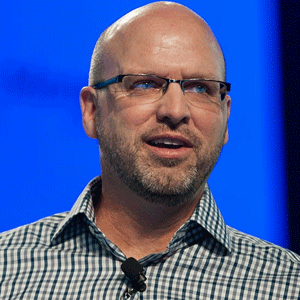
Brian Anderson, Director of Technology, Modern Restaurant Concepts

It is a very exciting time to be working with technology, particularly in the restaurant industry. We are starting to see a plethora of new products and solutions come to market for everything from labor management, sensor platforms, predictive analytics and invoice automation to loyalty and payment processing. Restaurants typically operate on small margins with high costs associated with food, labor, and rent. Tech companies see this as an opportunity for automation or data-driven services to help restaurant operators gain efficiencies through the automation of manual tasks and helping them make decisions based on real data. This is commonplace for industry verticals like manufacturing, airlines, hotels, and many others who have had access to supply chain data, order data, tickets sold, rooms booked, and all costs associated with their operations for years.

The restaurant industry has been a little trickier to predict until recently. With access to endless compute power through cloud platforms like AWS and Azure, machine learning algorithms as well as mountains of data from POS systems, labor scheduling platforms, accounting and back office applications and other data like customer loyalty, social media, and more have allowed tech entrepreneurs to build solutions that stitch these threads together to offer real-time predictive data as well as tools to help streamline operations and save costs.

We have also seen new solutions for payment processing with EMV, NFC, and customer loyalty programs woven together to create omni channel consumer experiences for transactions in-store, online, and through mobile apps.

You can now get your food the old fashioned way by showing up at a restaurant ordering and eating there, so 2oth century, or place your order for in-store pick up, curbside pick up, or delivery from any number of third-party platforms like DoorDash, GrubHub, or UberEats.

Let’s dive into sensors briefly. The cost to market has come down dramatically and you can buy a sensor for just about a few dollars. You can integrate them with BI tools for additional data streams or use them for notifications for your oven if it is left on or your walk-in cooler if it starts getting too warm. Operators can be notified to check on the equipment to avoid repair costs or inventory loss. You can also use sensors to track how many bodies come in and out of your restaurant to compare these counts with sales data, you can monitor where people congregate to improve restaurant design and even monitor employees to improve kitchen layouts or food production.

BUT... none of this stuff will work well unless you have a strong foundation in place. Most restaurants built in the last decade were not designed with a tech-forward approach in order to utilize all of these new tools. Ask yourself these questions. What is the internet speed at your business? I would recommend no less than 100mb but would encourage you to buy the most bandwidth you can afford. Do you have backup internet? What would your business do if it lost water or power? You would be limited at best and most likely dead in the water. The same applies to the internet; make sure you have an auto failover solution for backup internet so you can continue to access all of these new cloud-based tools. And last, are your operators ready for additional tools and data? If you don’t have standard procedures in place for labor management, inventory management, and training you will not be successful if you try and layer on more technology. Technology is not a replacement for solid operating practices, it is a tool to enhance these practices and provide your teams with additional information to consider when making decisions.

Build a strong foundation before you layer on additional solutions. Install the fastest internet connection you can and make sure you have an automated backup internet solution. Consider using cloud managed hardware for your firewalls, switches, and WiFi access points for easy visibility and remote management. This will give you a strong backbone to build on. Finally, prepare your teams, make sure you have the basics in place for inventory, scheduling, cost management, training, and daily operations so they are prepared when you turn up the tech.

tag

inventory

Sensor

Predictive Analytics

Machine Learning

AWS

Inventory Management

Weekly Brief

loading
Top 10 Food and Beverages Technology Companies - 2020
Featured Issue

I agree We use cookies on this website to enhance your user experience. By clicking any link on this page you are giving your consent for us to set cookies. More info

APAC CIOOutlook
Follow on LinkedIn

About

  • Home
  • About Us
  • Partner With Us

Stay Connected

  • Subscribe
  • Newsletter
  • Sitemap

Contact Us

  • editor@apacciooutlook.com
  • sales@apacciooutlook.com
  • marketing@apacciooutlook.com

Legal

  • Editorial Policy
  • Privacy Policy
  • Terms of Use

© 2026 APAC CIOOutlook. All rights reserved. Headquarteblue in Fort Lauderdale, FL, USA.

This content is copyright protected

However, if you would like to share the information in this article, you may use the link below:

https://food-and-beverages.apacciooutlook.com/cxoinsights/don-t-forget-your-foundation-nwid-6800.html